Doesn’t emptying the Trash already delete my files?+
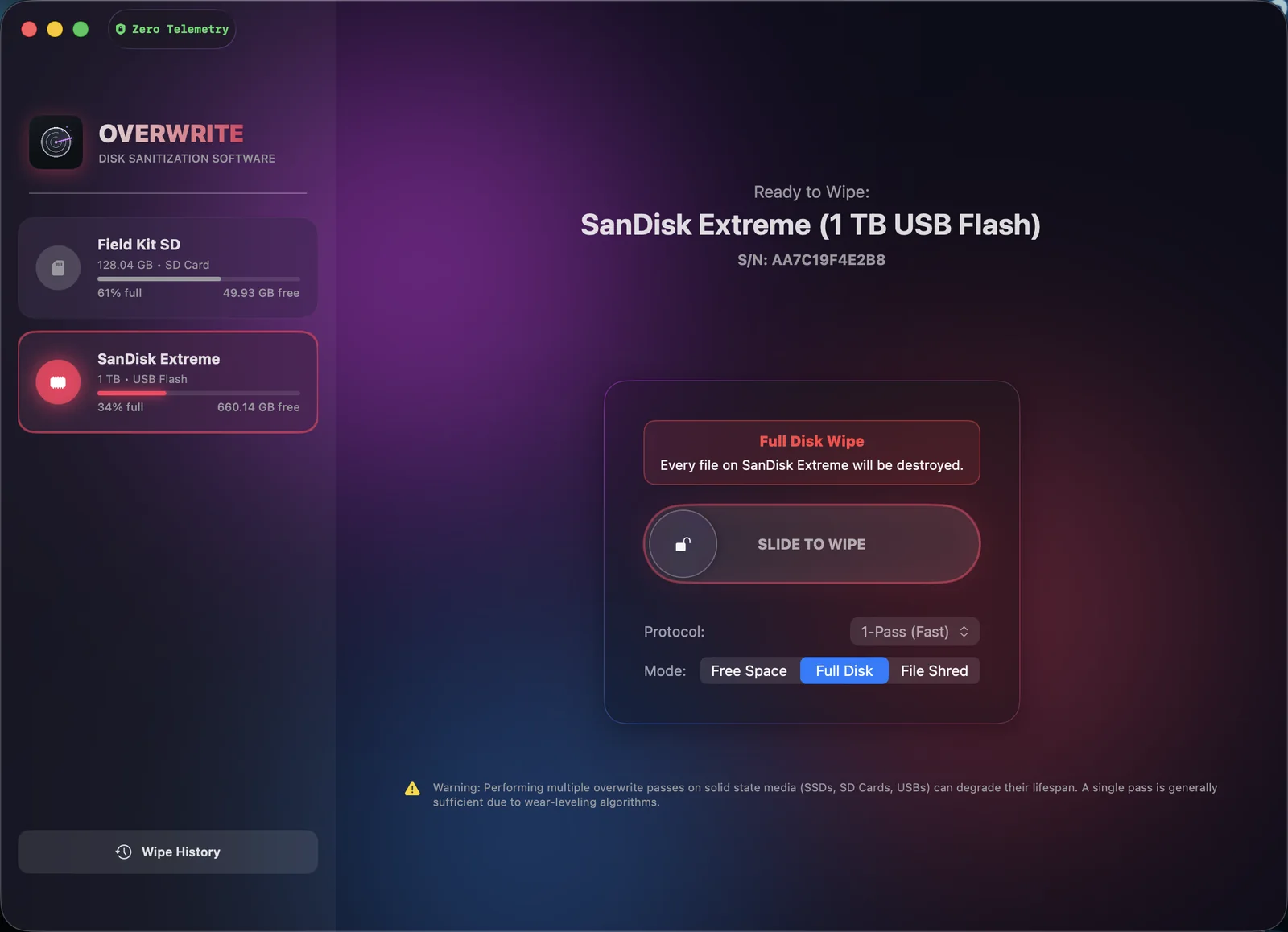
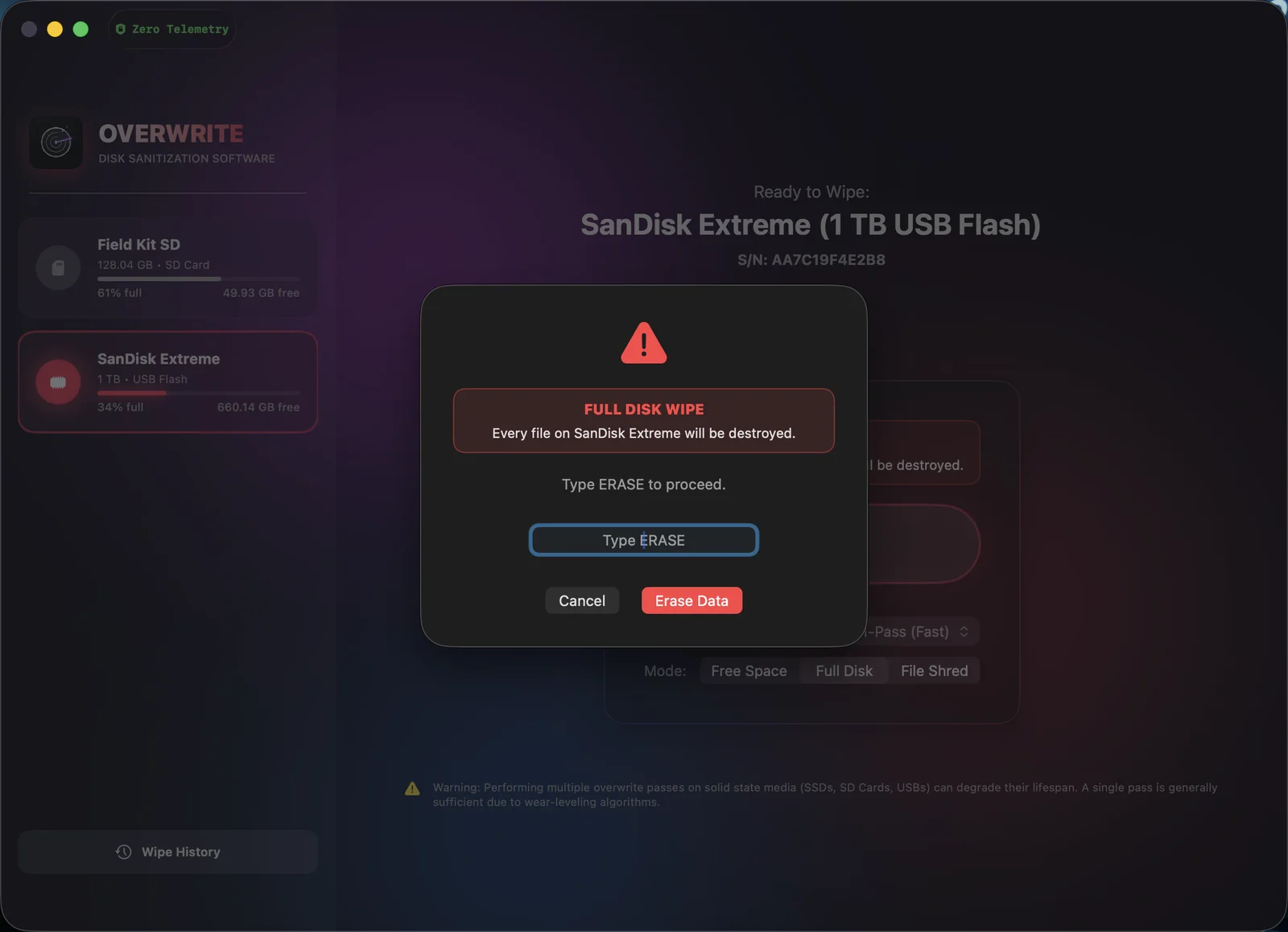
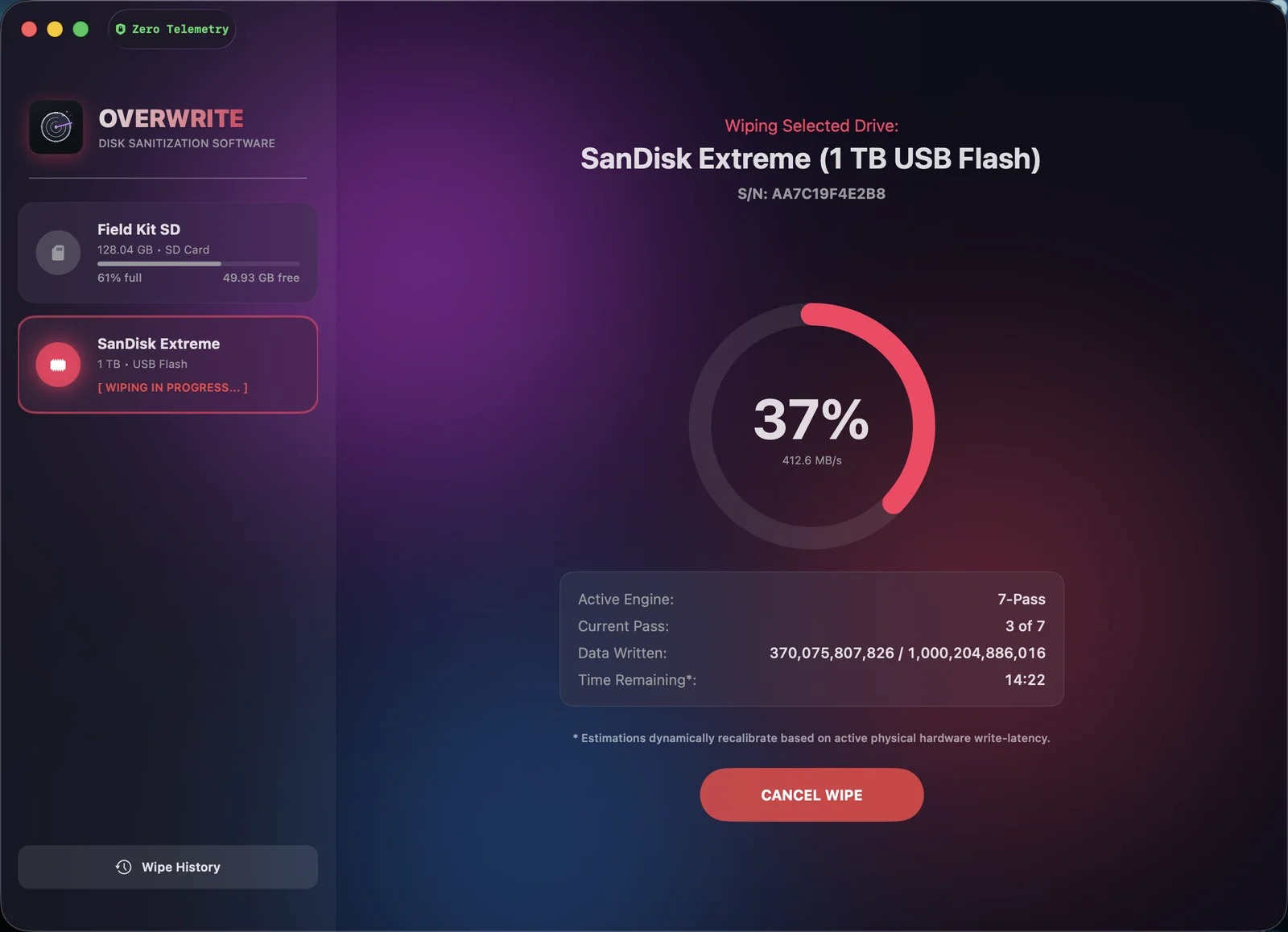
No — it only removes the directory entry that points to them. The actual data stays on the drive until it happens to be overwritten by something else. Free recovery tools can restore “deleted” files in minutes. Overwrite replaces the data itself with zeros or random data, so recovery software has nothing to find.
Is overwriting safe for SSDs and SD cards?+
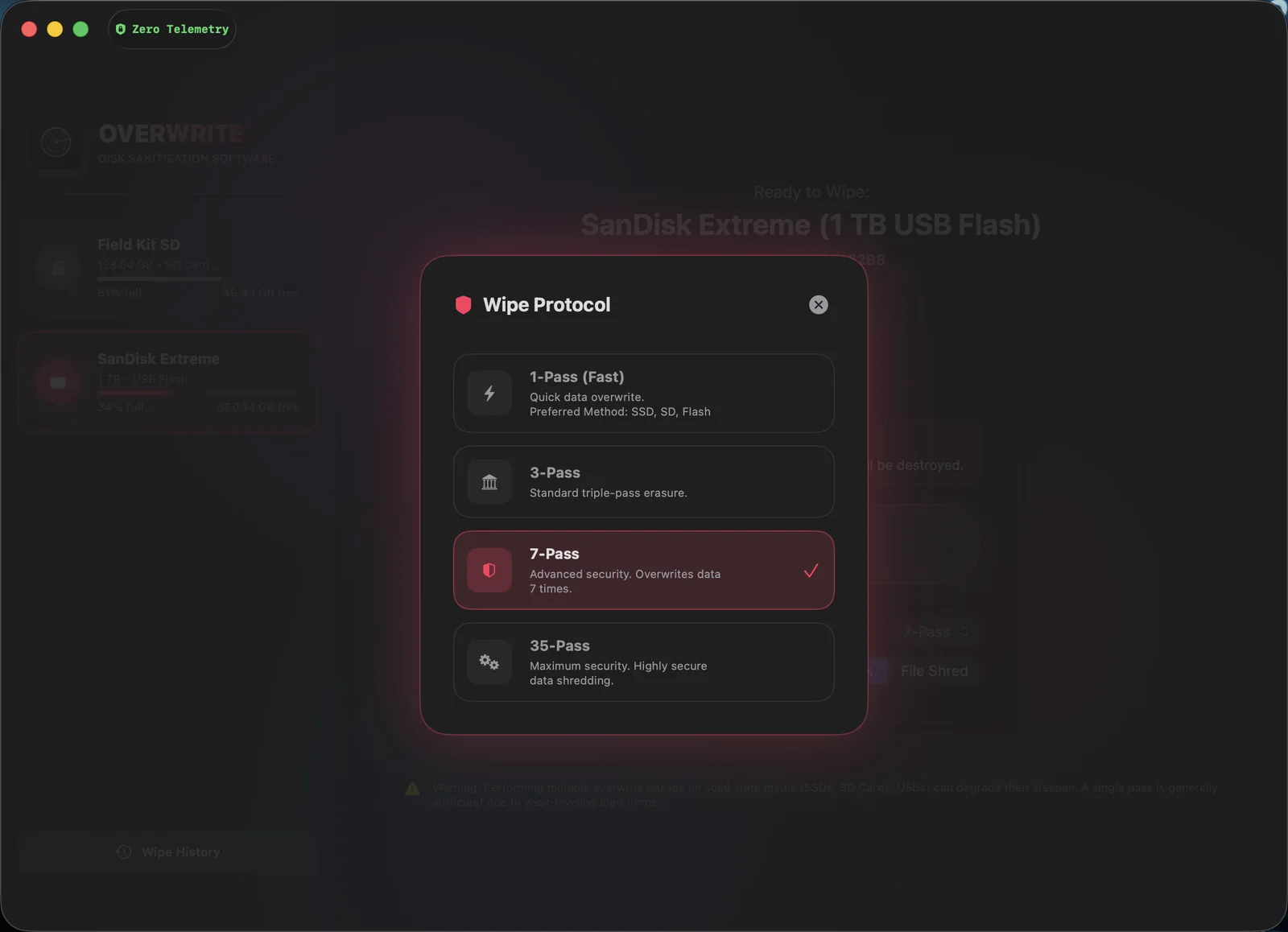
Yes. For modern flash media a single pass is generally sufficient because of wear-leveling, and both editions say so in the app rather than pushing you to burn write cycles. The 3-, 7- and 35-pass options are there when a policy calls for a pass count; they write fresh random data on every pass and are not the DoD 5220.22-M or Gutmann patterns.
Can Overwrite wipe my Mac’s internal drive?+
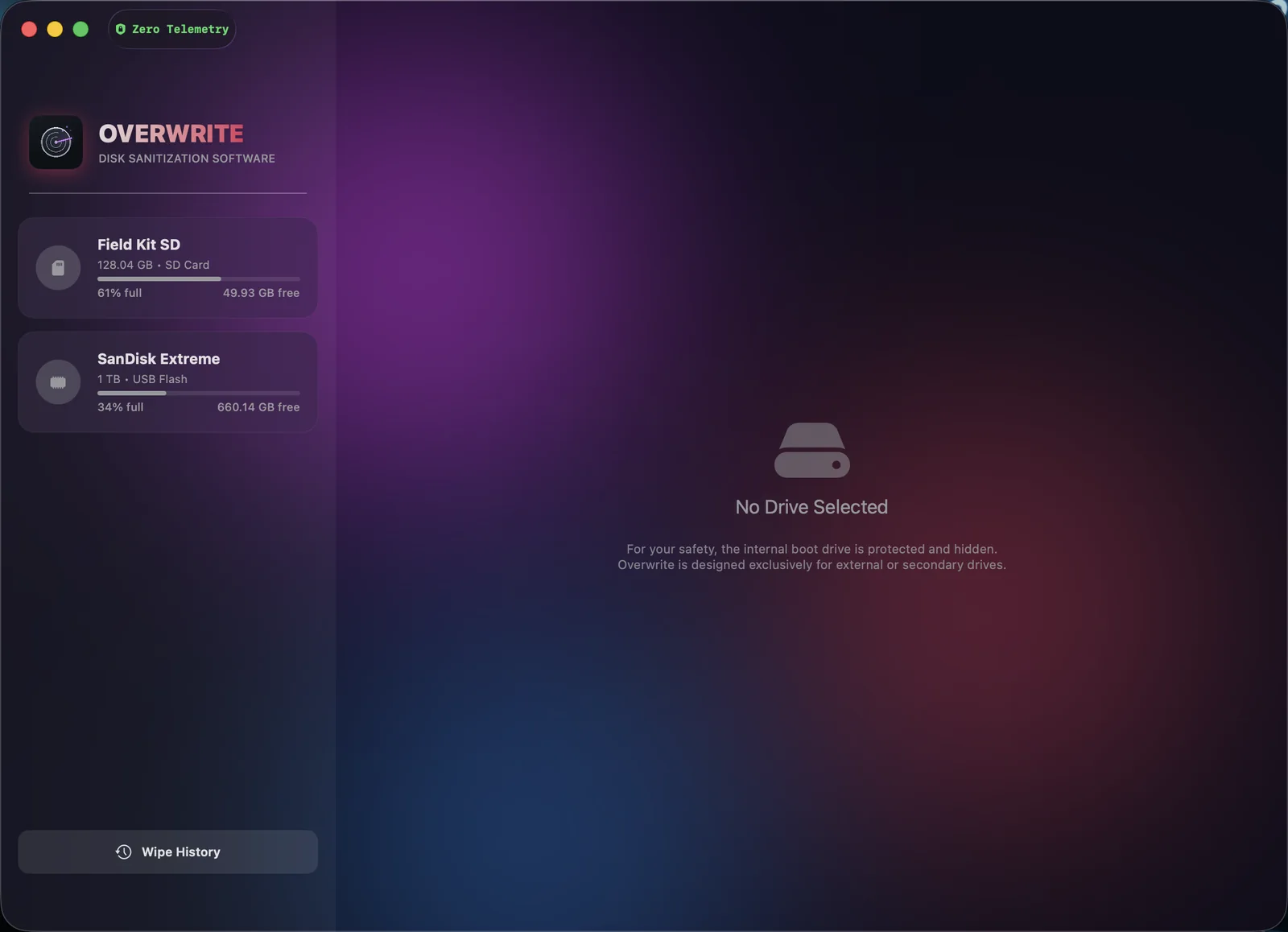
Deliberately, no. For your safety, the internal boot drive is protected and hidden — Overwrite is designed exclusively for external and secondary drives: USB sticks, SD cards, external SSDs and HDDs. You can’t accidentally nuke your Mac. Elite’s helper refuses your Mac’s own disks underneath the interface.
Does Overwrite send my data anywhere?+
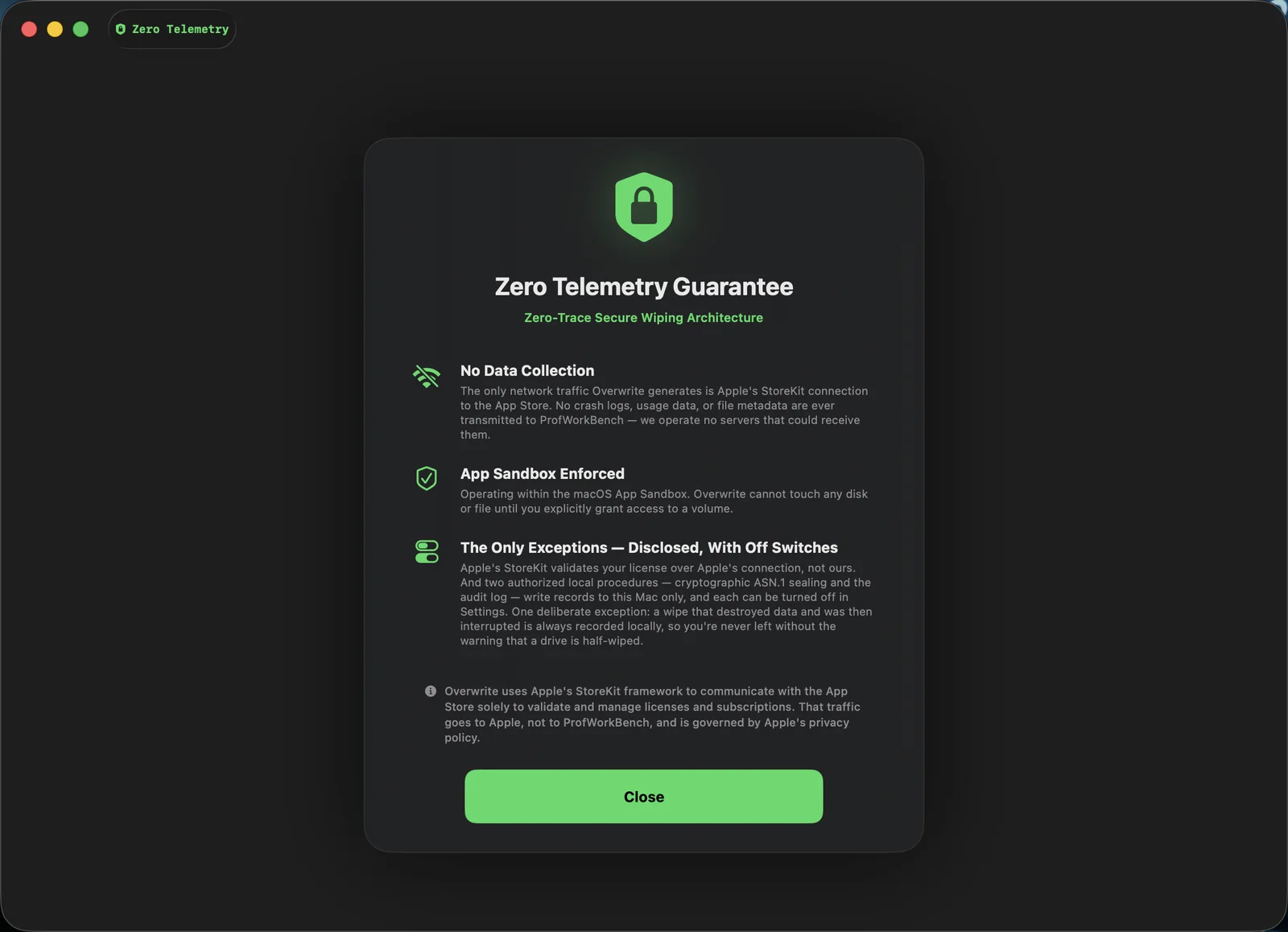
Never to us. Neither edition has analytics, crash reporting or an account, and nothing about your drives, files or wipe logs reaches ProfWorkBench. The App Store edition’s only connection is Apple’s StoreKit, for your licence. Overwrite Elite makes three disclosed connections — an update check, licence activation, and, while certificate sealing is on, a 32-byte hash to a public timestamp server — every one listed in the app.
What exactly is a Certificate of Erasure?+
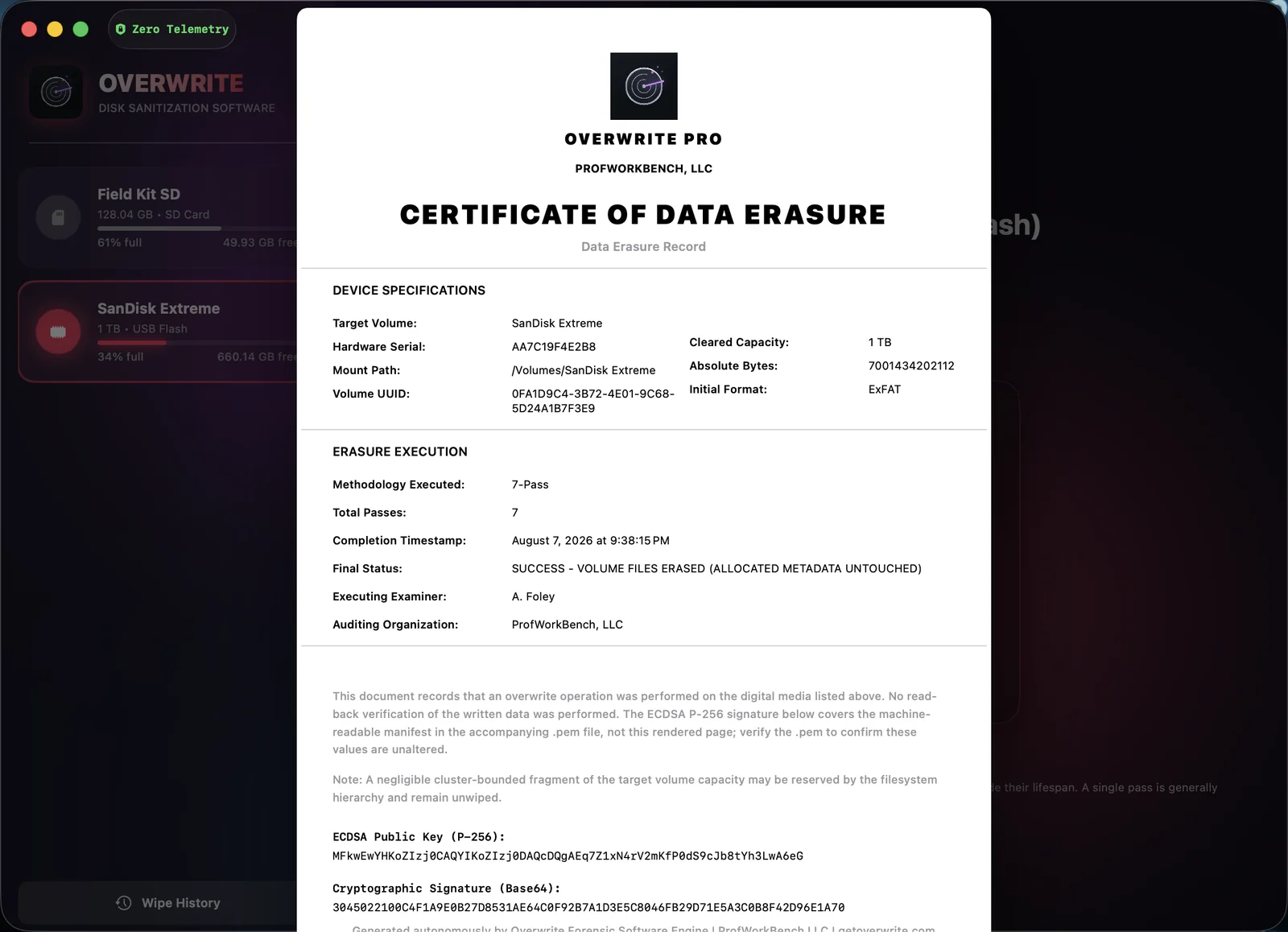
A PDF record of the device, the method and pass count, the bytes written, the timestamp and the examiner you entered, signed on your Mac with an ECDSA P-256 key so anyone can tell if it has been altered. Elite’s certificate also prints the measured write coverage and, when you enable read-back, how many bytes were read back and matched — and ships with a free verifier. Neither certificate claims a NIST SP 800-88 category; Elite’s states plainly that a host overwrite is a Clear operation, not a Purge.
What happens to APFS snapshots and read-only drives?+
Elite’s Full Disk mode overwrites the entire device, partition map included, so snapshots and hidden volumes go with it. Before any wipe on an APFS or multi-partition drive, both editions pause with an advisory and offer to open Disk Utility. A read-only drive cannot be written, so the wipe refuses to start and says so.
How do I securely erase a Mac I’m returning or selling?+
Use both tools for the job. Macs from 2018 onward (T2 chip or Apple silicon) encrypt their internal drive in hardware — even with FileVault off — so Apple’s built-in “Erase All Content and Settings” destroys the encryption keys and permanently sanitizes the Mac itself. Then run Overwrite on every external drive, USB stick, and SD card that goes with it — those have no built-in protection at all. (Older Intel Macs: turn on FileVault, let it finish, then erase.)
Which edition do I need?+
If you need the whole device overwritten, a read-back you can point to, or a certificate a stranger can verify — Elite. If you want to clear a USB stick or SD card before it leaves your hands, the App Store edition does that from the sandbox for $12.99 a year or $24.99 once.